
RUBICON STRUCTURE


One of the Russian military’s most important developments in 2024-2025 was the establishment of the Rubicon Center for Advanced Unmanned Technologies under the Ministry of Defense’s Directorate for Advanced Inter-Service Research and Special Projects. As with many Russian innovations in the war, Rubicon’s genesis was a response to Ukrainian innovation. In part, it was a reaction to Ukraine’s Drone Line initiative and innovative Ukrainian drone units. Rubicon was officially established on August 2, 2024, by the order of Minister of Defense Andrei Belousov a few months after his appointment. This decision was a logical step in improving the procurement and development of unmanned systems in the Russian military. While organizations like the “Judgement Day” project played an important role, their experience and innovations were not shared uniformly across the Russian military and their funding relied on support from volunteers. The Rubicon Center was established to centralize research and development, analysis, procurement, and combat deployment of unmanned systems, including unmanned aerial systems (UAS), ground vehicles (UGV), and surface vessels (USV).'
Rubicon has a broad remit. It plays an active role in developing the doctrine for the employment of unmanned systems: developing and spreading new tactics, techniques, and procedures (TTPs) across the military, training unmanned systems forces’ units, and improving and modernizing unmanned systems and other technologies. Since its formation, Rubicon has been a high priority for Minister Belousov. It is well funded and able to operate differently than conventional forces with a distinct culture. Its members are paid similarly to specialists from the Special Operations Forces (SSO), a significantly higher compensation than that of conventional forces. At the start of operations, it could also afford to be much more selective about the personnel it recruited, and was authorized to take unmanned systems teams from conventional forces.
In addition to its headquarters, Rubicon consists of combat formations. These units, mostly detachments, played a notable role in priority directions along the front line in 2025. Rubicon detachments were a qualitative improvement over conventional drone units, with substantial quantities of drones available and a much greater capacity for innovation. They also pursued more specific missions, typically targeting UAS teams and logistics targets at greater distances behind the front line. These detachments were tasked with experimenting with new equipment and tactics, which could be shared across the military. As a group of forces-level assets, they played an important role in reducing the time required between locating and striking targets, thus broadly improving the kill chain. In several respects, Rubicon combat detachments would ameliorate systematic issues or problems conventional forces could not fix. This included training UAS and counter-UAS (CUAS) crews from conventional units in the occupied areas on the latest TTPs and lessons learned. To some extent, Rubicon has compensated for the conventional forces’ generally slow adaptation cycle through its own innovations. Unlike other units, Rubicon detachments receive equipment directly from manufacturers and provide direct feedback, which leads to a more rapid drone innovation cycle.
Rubicon Center’s Approximate Structure in 2025
Rubicon includes a total of seven departments or centers, but it is important to emphasize that its structure is constantly evolving. Russia is actively scaling the number and size of its unmanned systems formations, which will likely continue. The main components of its structure include a headquarters, drone development center, instructor training center, analytical center, supply/sustainment unit, and combat formations.
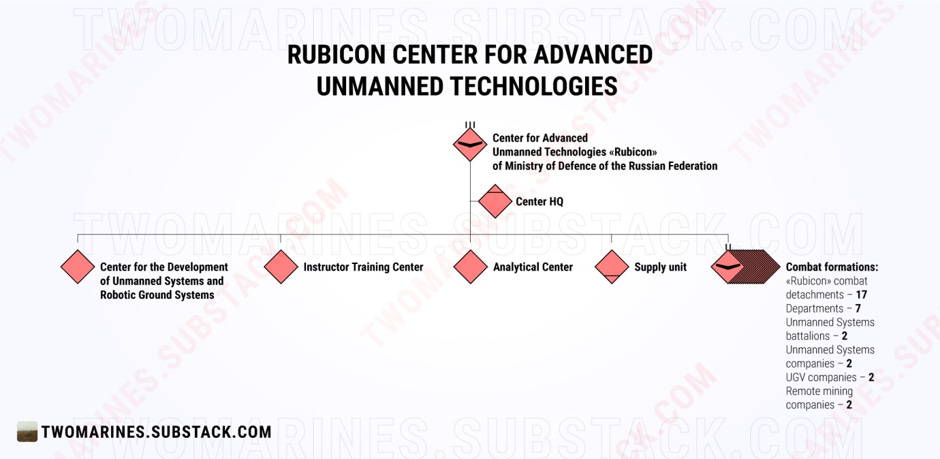
Rubicon has a command group led by the center commander as well as seven deputy commanders responsible for religious support/unit ministry team (chaplain), physical readiness, legal affairs, research and development, combat training (G7), combat operations (G3), and political affairs/FSB counterintelligence officer. Next is the headquarters/staff led by the chief of staff. It consists of an operations section (G3), signal section (G6), intelligence section (G2), command post, personnel/manning section (G1), state secrets protection office/classified control office, UAS service section (cell), electronic warfare section, and communications control post (signal control node).
There is a sustainment and support section that consists of a technical directorate with a deputy commander for armaments, chief of technical inspection point (maintenance control point), and automotive service officer (motor pool). A logistics/sustainment directorate (G4) is led by the deputy commander for logistics with an organizational planning section and materiel and technical support department. The section also consists of a financial management office, human resources department, and specialized services, which typically include a RKhBZ (CBRN) defense officer and an air defense officer. In total, the command group, headquarters/staff, and sustainment section included approximately 100 personnel.
The next section is the operational test and combat employment units, which consist of a heavy FPV UAS test detachment, UAS test and evaluation detachments, an unmanned surface vessel (USV) test detachment, a special unmanned ground vehicle (UGV) test detachment, and an air defense systems test detachment. The Center also has its sustainment/supply units, including a warehouse section, medical aid station (role 1), transportation company/motor transport section, maintenance and repair unit, and security/force protection platoon.
The research and development block consists of six departments: innovation and advanced technology development, capability integration and fielding, analytical, medical technology development, training, and communications, and command and control systems. The innovation and advanced technology development department has a variety of functional groups: multirotor UAS, fixed-wing UAS, unmanned ground systems, unmanned surface systems, computer vision, artificial intelligence, software development, electronic warfare systems development, signals intelligence and electronic protection systems, UGV control systems development, field testing and validation, reverse engineering, and a defense industry cooperation cell.
The capability integration and fielding department includes the following groups: FPV systems, medium-range heavy UAS, EW and SIGINT systems integration, unmanned surface vessel integration, UGV systems integration, and technical sustainment. The analytical department includes the UGV employment analysis group, internal systems technical support group, software engineering group, and open-source and media analysis (OSINT) group. The medical technology development unit consists of an operator performance and human factors lab and an interactive training systems lab. The training department includes a command element, six training platoons with 18 personnel each, and a training support platoon. Lastly, the communications, command, and control systems department includes an experimental communications systems test group, fielded communications systems integration group, and technical maintenance group.
Table of Organization for Rubicon Combat Formations
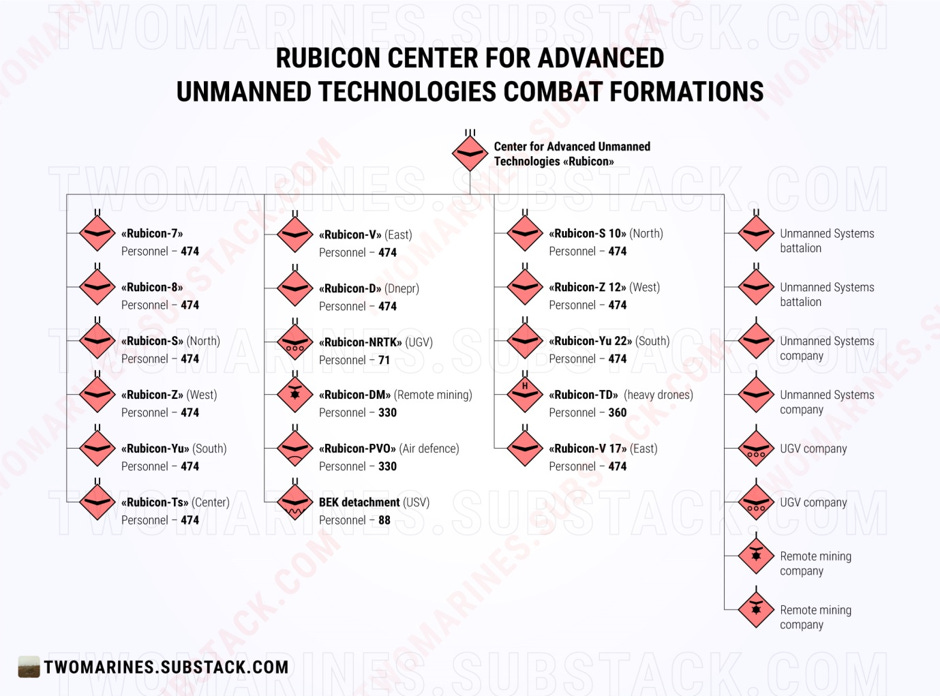
In April 2025, there were eight Rubicon detachments. Six of these detachments were formed subordinate to each of Russia’s six groups of forces. These were the Rubicon-S (North), Rubicon-Z (West), Rubicon-Yu (South), Rubicon-Ts (Center), Rubicon-V (East), and Rubicon-D (Dnepr) detachments. The table of organization for the six detachments was 149 personnel, but their actual numbers ranged between 120-141 personnel, or 85% strength on average in April 2025. Russia also formed the Rubicon-Reserve and Rubicon-DM (Distance Mining) detachments, which were subordinate to the Joint Group of Forces led by General Gerasimov, which commands the war. Since then, Rubicon has scaled considerably with a total of 17 detachments, 2 unmanned systems battalions (roughly half the size of a detachment), and six companies.
Elements from Rubicon-S, Rubicon-Yu, and Rubicon-D were employed in Kursk oblast and played a key role in Russia’s retaking the salient held by Ukrainian forces around Sudzha. They were redeployed primarily to the Donetsk region in April, and had an immediate effect on the fighting in that direction. The Kursk operation was an immediate demonstration of Rubicon’s effectiveness. Retaking Kursk was a key political goal for Russia, and the new method of reinforcing areas of the front with elite strike UAS units focused on disrupting logistics demonstrated results.
As with Ukraine’s Unmanned Systems Forces’ units, including the regiments and brigades in the Drone Line initiative, Rubicon detachments and teams are sent to reinforce priority directions. Given their capabilities and resources, the deployment of Rubicon detachments is a strong indication of Russia’s priority directions for offensive operations. During much of the summer and fall of 2025, there were several Rubicon detachments operating in support of the Center Group of Forces (GOF), whose area of responsibility includes Pokrovsk, Myrnohrad, and Dobropilla. In addition to the Rubicon-Ts detachment, which should be operating under the GOF, elements from Rubicon-D (Dnepr), Rubicon-7, Rubicon-8, Rubicon-DM (Distance Mining), and Rubicon-PVO (Air Defense) were all supporting Center GOF during this time. Russia also redeployed its naval infantry brigades and regiment to this direction at the end of the summer, which conducted several company-size mechanized assaults as well as dismounted infiltration. The redeployment occurred after the deep infiltration in mid-August. This was Russia’s main axis of advance during the second half of 2025, with the objective of advancing to Barinkove in Kharkiv oblast where they planned to meet units from the Western Group of Forces advancing from the Lyman direction. If successful, this would have encircled the cities of Slovyansk, Kramatorsk, Druzhkivka, and Konstyantinivka.
On the other side, they faced many of Ukraine’s most capable UAS units, including elements from Magyar’s Brigade, Lasar’s Group, the Rarog Regiment, and other units. Russia did manage to advance and occupy most of Pokrovsk and Myrnohrad during this time, but failed to exploit the deep infiltration that occurred east of Dobropillia in August. The deployment of several assault regiments, special operations forces, UAS units, and the redeployment of the 1st Azov Corps headquarters managed to stabilize and then improve the situation, despite the deployment of so many Rubicon teams. According to brigades in the Konstyanikvka direction, some Russian advances were attributable to Rubicon’s actions. Once they could not resupply their infantry or UAS positions in some areas, they could not sustain their positions and counter Russian infiltration. Rubicon has thus far managed to complicate the situation for Ukrainian brigades holding the front line, but, so far, this not been sufficient to enable a breakthrough.
Table of Organization and Equipment for Rubicon Detachments
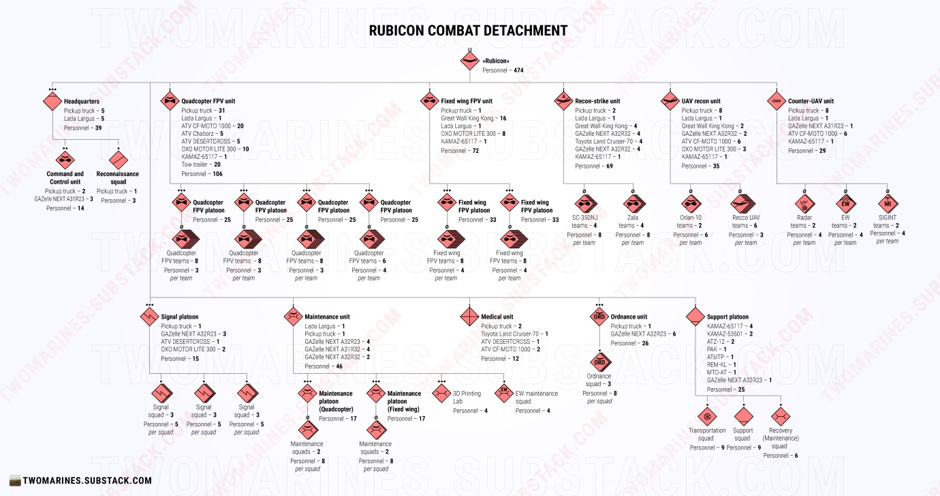
Rubicon not only scaled the number of combat formations, but also the size of its detachments. With the increased size and diverse capabilities, detachments can now operate more autonomously and can perform a greater variety of missions. The standard Rubicon detachment increased in table of organization strength from 149 personnel in early 2025 to 474. Out of this total, there are 52 officers, 46 warrant officers, 78 sergeants, and 298 soldiers. The command section has 39 personnel, including the commander, deputy detachment commander, deputy detachment commander for operations (S3), deputy detachment commander for logistics (S4), head of communications service (S6), and deputy detachment commander for armaments/chief of materiel. The command also includes the staff of 22 personnel with the chief of staff, deputy chief of staff, two assistant chiefs of staff, an instructor, reconnaissance/intelligence section with three personnel, and battle command group with 14 personnel.
The detachment’s combat component has 245 personnel. The quadcopter FPV group has 106 personnel and is led by the group commander and deputy group commander for operations. It is composed of 4 FPV platoons, each led by an officer. Three of these platoons have eight teams with three personnel each and the 4th platoon has six crews with four personnel per team. Each team is led by a sergeant. There is also a fixed-wing FPV group of 72 personnel. This group has two platoons with eight teams each. Each team has four personnel. The reconnaissance-strike group has 69 personnel with four S-350NJ Supercam and four Zala ISR UAS teams. Each of these teams has seven personnel with pilots for both ISR and loitering munition UAS (typically, a Lancet variant). Each of these teams is led by an officer with two warrant officers. The aerial reconnaissance group has 35 personnel with two Orlan-10 UAS teams and six additional ISR UAS teams. The Orlan-10 teams are led by officers and have five personnel, whereas the regular ISR teams have three personnel and are led by sergeants. The detachment has a counter-UAS group of 29 personnel with two radar teams, two electronic warfare teams, and two radio-electronic reconnaissance teams. There is also a communications platoon with 15 personnel, an ordnance group, maintenance group, support platoon, and a medical evacuation group.
Recent Developments
In addition to the broader expansion of the Unmanned Systems Forces branch in 2026, the Russian military continues to scale the size of Rubicon as well as the 50th “Varyag” Unmanned Systems Brigade. Most of this expansion is occurring in its combat formations. At the end of March 2025, Rubicon’s total strength was approximately 1,450 personnel with an authorized strength of 2,500. As of this spring, Rubicon had approximately 5,000 personnel with an authorized strength of 9,000. This includes approximately 175 personnel in the headquarters, 270 personnel across seven departments (including research and development), and 700 involved in training and support functions. The remainder of personnel are in combat units.
While Rubicon remains a critical component of the Russian military’s unmanned systems’ capabilities, its future role is unclear. Interestingly, it appears the 50th “Varyag” Unmanned Systems Brigade may become the critical unit for Unmanned Systems Forces. Both Rubicon and the 50th Brigade are now tasked with countering Ukraine’s increasingly successful middle strike campaign, a key priority for the Russian military. The 50th Brigade will deploy battalions to help defend the airspace in Russian regions neighboring Ukraine, with Rubicon focused on defending occupied areas.
The previous commander of Rubicon was Colonel Sergei Viktorovich Budnikov, who previously served with the 61st Naval Infantry Brigade and 9th Guards Artillery Brigade. However, he was replaced as the commander of Rubicon by Sergei Aleksandrovich Zbukarev and is now the commander of the 50th Brigade. Approximately 600 personnel from Rubicon transferred to the brigade with him. The change in leadership and movement of personnel suggests that Rubicon may eventually lose its central role in the development of unmanned systems. There have been multiple attempts to significantly alter Rubicon, including removing or reducing its research and development center.
The emphasis on rapidly scaling Rubicon’s combat detachments appears to be creating challenges. The center was authorized to poach UAS teams from conventional regiments and brigades. Therefore, the further scaling of its combat formations is, at least partially, coming from conventional forces. This will likely lead to weakening the organic intelligence, surveillance, and reconnaissance (ISR) and UAS fire support capabilities for ground units. Notably, the same thing occurred when Ukraine scaled its Drone Line regiments and brigades, which took many of the best pilots and teams from the maneuver brigades, leaving them, at least temporarily, weaker. To increase its size, Rubicon has lowered its standards. As with special operations forces, attempts to increase size too rapidly will result in a drop in quality. While Rubicon’s growth is contributing to more target strikes each month, it is also tasked with greater responsibilities to address the Russian military’s growing challenges in the war. But these challenges need to be addressed in a more systematic fashion by conventional forces.
Rubicon is also competing for talent with the 50th Unmanned Systems Brigade, which is attempting to increase its size from 1,300 personnel to 7,000. The Unmanned Systems Forces had approximately 87,000 personnel at the end of 2025, with plans to reach 165,000 by the end of 2026. Russia is currently failing to meet its monthly recruitment quotas. The plan includes recruiting 68,000 contract soldiers and transferring 10,000 servicemen from elsewhere in the military this year, but, if recruitment of civilians is insufficient, more servicemembers will likely be transferred. Russia is also scaling the size of its unmanned systems units at all levels, including elevating newly-formed unmanned systems regiments subordinate to military districts and fleets into brigades. The scarcity of talent, and struggle to recruit Russia’s most capable and technologically savvy young men and women, will remain a key constraint.
Thanks for an excellent article!
Have other militaries begun to establish large Unmanned Systems units?